·Central Arkansas
The Beginner's Guide to Lead Generation Funnels: Turn Strangers Into Customers
Monday, August 10, 2026
Systems Beat Guesswork
If your leads show up in bursts — a great week followed by three weeks of silence — you don't have a marketing problem. You have a systems problem. Most business owners are stuck reacting: posting when they remember, following up when they think of it, hoping the phone rings. It's exhausting, and it's completely unpredictable.
There's a better way, and it doesn't require a bigger budget or a marketing degree. It requires a funnel — a repeatable system that takes a total stranger and walks them, step by step, toward becoming a paying customer. This guide breaks down exactly how that works, in plain language, so you can build your first one this week.

What Is a Lead Generation Funnel?
Picture an actual funnel — wide at the top, narrow at the bottom. Pour a lot in at the top, and a smaller, more concentrated amount comes out the bottom. A lead generation funnel works the same way with people.
At the top, you have a large pool of strangers who've never heard of you. As they move through the funnel, some drop off — and that's normal — but the ones who stay become more engaged, more informed, and more ready to buy. By the time they reach the bottom, they're not strangers anymore. They're customers.
The magic isn't the shape. It's that every stage has a job to do, and when each stage does its job well, the whole system produces predictable results instead of random luck.
The 4 Core Stages
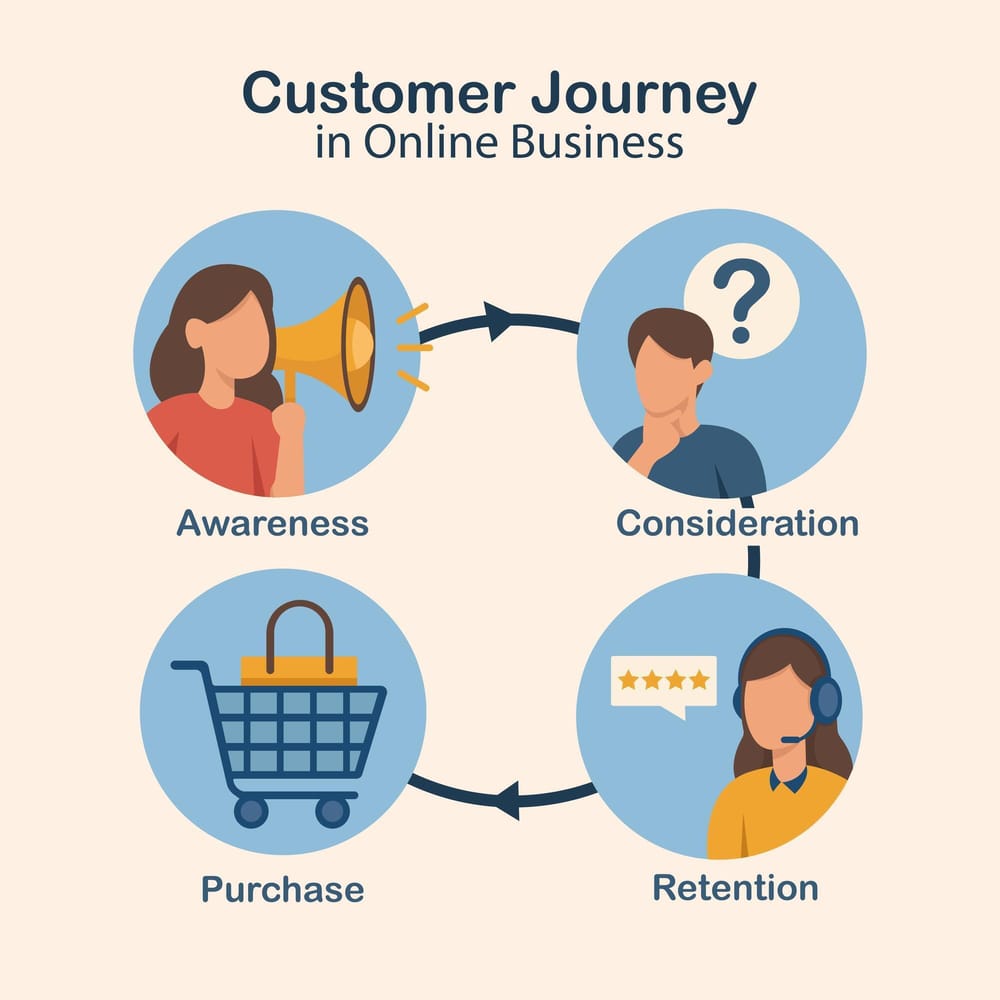
Every effective funnel — no matter the industry — moves people through the same four stages. Understanding what belongs in each one is the difference between a system that converts and a pile of disconnected marketing tactics.

1
Awareness
This is the top of the funnel — the moment a stranger first discovers you exist. Nobody buys at this stage. The only goal is visibility.
- Social media content that answers real questions your audience has
- Blog posts and SEO that get found when people search for solutions
- Paid ads targeted to your ideal customer
- Referrals and word-of-mouth from happy customers
2
Interest
Once someone notices you, the next job is to earn a small commitment — usually their name and email — in exchange for something genuinely useful. This is where a stranger becomes a lead.
- Lead magnets like free guides, checklists, or templates
- Email opt-ins tied to a specific problem you solve
- Webinar or workshop registrations
- Interactive quizzes that give a personalized result
3
Decision
Now the lead is actively weighing whether you're the right choice. They're comparing options, reading reviews, and looking for a reason to trust you over the alternative.
- Case studies and testimonials that prove real results
- Clear comparisons that show why your approach is different
- Limited-time offers that create a reason to decide now
- Personalized follow-up emails that answer common objections
4
Action
This is the conversion moment — the point where a lead becomes a customer. Everything before this stage was designed to make this step feel easy and obvious.
- Clear, unmistakable calls to action
- A streamlined checkout or booking process with no friction
- Urgency and scarcity elements used honestly and sparingly
- A thank-you page that immediately sets up the next step
Why Funnels Beat Traditional Marketing
Traditional marketing throws messages out and hopes something sticks. A funnel is different — it's a designed path with a job at every step, which means you can measure it, improve it, and trust it.
- Predictable, trackable results instead of guesswork
- Every step is measurable, so you know exactly where prospects drop off
- Automated follow-up nurtures leads while you sleep
- Scales without requiring more of your personal time
- Systematically turns cold traffic into warm, ready-to-buy customers
The businesses winning in today's market aren't necessarily the ones with the biggest budgets. They're the ones with the best systems.
Getting Started: Your First Funnel in 3 Steps
You don't need a complicated system to get results. You need one clear path from stranger to customer. Here's the simplest version you can build this week.
1
Define one offer and one audience
Pick a single problem you solve for a single type of customer. Trying to speak to everyone is the fastest way to convert no one.
2
Build a simple lead magnet and landing page
Create one genuinely useful piece of value — a checklist, a short guide, a quick assessment — and a single page where people can trade their email for it.
3
Set up a follow-up sequence and test it
Write three to five follow-up emails that build trust and lead toward your offer. Send real traffic to it, watch what happens, and adjust based on where people drop off.
Final Thoughts
You don't need a perfect funnel to get started — you need a working one. The businesses that win aren't the ones with the flashiest campaigns; they're the ones who built a simple system, tested it against real traffic, and improved it a little at a time.
Start with the four stages. Give each one a job. Then let the data — not your gut — tell you what to fix next.
That's it. That's the whole system.
Ready to Build Your First Funnel?
Stop relying on random posts and hopeful guesses. Put a real system to work and start turning strangers into customers on a predictable schedule.

Hi, I Am FMG - Adarian
CEO Of Funnel Marketing Guy!
Most growth problems are funnel architecture problems. Build your first funnel to break even, acquire customers at no cost, then profit through Funnel Stacking.
Get Your FREE ClickFunnels Trial
Funnel Marketing Guy LLC - © 2026 All Rights Reserved | P.O. Box 20092 Hot Springs, AR
Terms - Customer Support - Privacy - Refund Policy - Cancellation Policy
How it Works - Legal & Usage - Promotions & Trials